

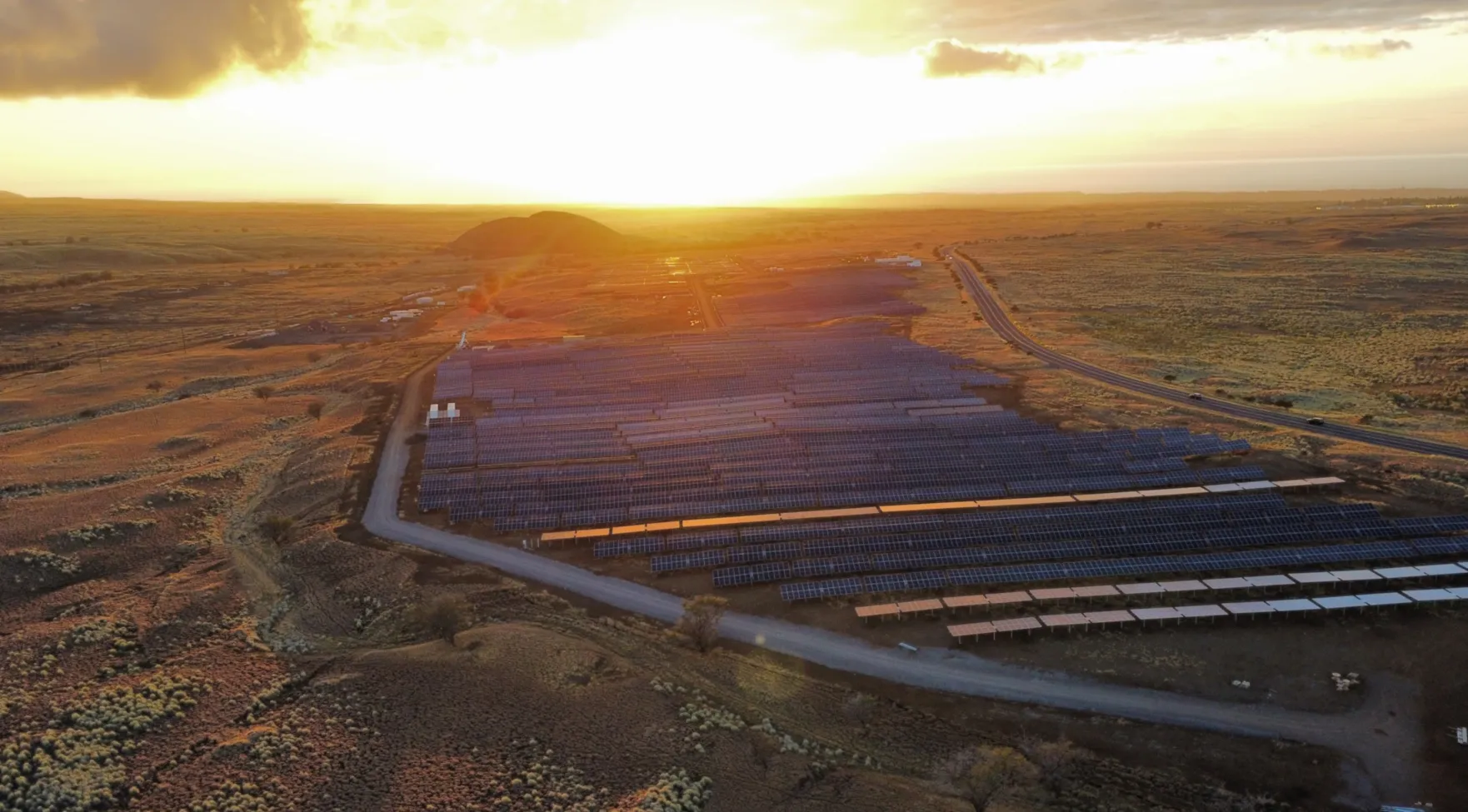
AES Hawai'i and its environmental consultant conducted a preliminary assessment of the environmental conditions at the site based on a review of publicly available maps, studies and previous environmental reports prepared for the property through a Phase 1 Environmental Site Assessment (ESA). More detailed information is being obtained through the due diligence and site-specific studies, as well as community feedback, and will be used to inform the design process.
The Project design will seek to avoid and minimize environmental impacts to the extent possible. Best Management Practices (BMPs) will be implemented to further minimize impacts throughout the Project lifecycle.
Feedback will be collected throughout the Project lifecycle, and updates will be provided as outlined in the Community Outreach section. To get the latest project information sign up to be placed on our mailing list.
-
Natural environment
-
Air Quality:
None of the equipment associated with the solar arrays or battery storage system emit air pollutants of any kind. Overall, the Project would provide a net benefit by replacing energy generated by burning fossil fuels with renewable energy, thereby reducing emissions of greenhouse gases.Biology:
A site‐specific biological survey would be conducted as part of the detailed due diligence effort and the results would be incorporated into the planning and design process; if any sensitive biological resources are identified during this survey, the appropriate steps will be taken to avoid, minimize and mitigate potential impacts.Natural Habitats and Ecosystems, Vegetation and Wildlife:
Based on available information, the Project area has likely been disturbed by past land uses, such as cattle grazing, which has presumably reduced the number and abundance of native species. In addition, a relatively recent wildfire that burned the northeastern corner of the Project area (Hawaiʻi Wildfire Management Organization 2013) has likely further transformed the habitats and ecosystems in the Project vicinity.Data from a statewide habitat assessment by U.S. Geological Survey characterize the Project area as comprised of mixed native and non‐native habitat in the central and northeastern portions, with patches of bare to sparsely vegetated areas in the western portion. It is likely that most of the Project area is dominated by non‐native species, particularly fountain grass (Cenchrus setaceus) and buffelgrass (Cenchrus ciliaris).
Wildlife expected to occur within the Project area include nonnative species that are typically found in disturbed areas on Hawaiʻi Island. Two previous biological surveys conducted in the Project vicinity recorded only non‐native birds, mammals, and insects. No critical habitat for wildlife species has been designated within or adjacent to the Project area.
Available data indicate the Project area does not contain any perennial streams or wetlands (USFWS 2022a). However, several non‐perennial (likely ephemeral) streams are identified in the Project area including two branches of ʻAuwaiakeakua Gulch and two branches of Popo‘o Gulch. The location of these features would be verified through a field assessment and the jurisdictional status would be verified with the U.S. Army Corps of Engineers (USACE).
In addition to the habitat types described above, it is important to note that the Project area is located on a geological substrate (pāhoehoe lava flows) where caves and lava tubes may be present. Should any caves or lava tubes be identified within the Project area, these would be investigated as part of the due diligence process and avoided as appropriate.
The Project is being designed to minimize ground disturbance and maintain ample, natural open space surrounding the Project facilities. Impacts to natural resources, including listed species that could possibly occur within or traverse over the Project area, will be avoided and minimized to the extent possible through implementation of standard measures.
Climate:
The Project would generate clean renewable energy which would replace the burning of fossil fuels for the production of electricity, thus offsetting greenhouse gas emissions and providing a beneficial impact on climate conditions.Soils:
Ground disturbance during construction would be primarily related to driving steel posts to support the racking system for the solar panels, trenching for placement of electrical wiring, and excavation for foundations for the battery storage units, substation and interconnection facilities. All equipment will be removed, and the site restored after the life of the Project leaving the soils in the same condition prior to construction.Topography and Geology:
Topographic surveys have been conducted to inform project design as well as to minimize ground disturbance to the greatest extent practicable. Project design will continue to be refined as additional site studies are conducted. -
Land regulation
-
Land Uses:
There will be no long-term impacts to future uses for this land.After the life of the PV + BESS facility the land will be restored for future uses.
Flood and Tsunami Hazards:
The Project has been sited to ensure Project infrastructure is outside the Hawai‘i Tsunami Evacuation Zone, and the Hawai‘i Department of Land and Natural Resources flood map’s flood zones A, AE, AEF, AH, AO, VE based on the Federal Emergency Management Agency’s Digital Flood Insurance Rate Maps.Noise:
The Project is not anticipated to generate meaningful noise impacts when operational. However, AES still plans to perform a noise assessment and, if required, obtain a noise permit for work during construction.Roadways and Traffic:
A Traffic Impact Analysis Report (TIAR) has been prepared and any required mitigation will be implemented during the construction phase of the Project. Once operational and for the duration of the project, it is anticipated there will be minimal new traffic generation.Utilities:
This project will not require any utilities during construction.
-
Socio-economic characteristics
-
The site is currently vacant land with similar uses surrounding the Project site. AES Hawai'i utilized the State of Hawai‘i Department of Business, Economic Development & Tourism (DBEDT) Map of Electricity Burdens on Hawai'i Households by Census Tract to preliminarily assess the Project’s location and distance from nearby residents and the energy burden (defined as percentage of gross household income spent on energy costs) of those closest communities. The site is located approximately 4.0 miles away from the nearest community with an average electricity burden of 3.89%.
According to the American Council for an Energy-Efficient Economy (ACEEE), the Median energy burden nationally is 3.1% and the median low-income energy burden is 8.1%, which puts this area at slightly above the national average for non-low-income households. According to the same source, a high energy burden is considered to be above 6% and a severe energy burden above 10%.
-
Aesthetic/visual resources
-
A visual impact analysis has been conducted and the Project will be designed to minimize visual impacts to the extent practicable.
-
Solid waste
-
The facility is not anticipated to generate solid waste.
-
Hazardous materials
-
A Phase 1 Environmental Assessment was conducted for the site and it was confirmed that no recognized environmental conditions (RECs), historical RECs (HRECs), or controlled RECs (CRECs) in connection with the subject property.
-
Water quality
-
A Waters of the U.S. Delineation and Jurisdictional Determination will be conducted prior to construction and any potential jurisdictional water feature is expected to be avoided such that the Project would not result in discharge to Waters of the U.S.
-
Public safety services (Police, Fire, Emergency Medical Services)
-
The Project is located near dense population centers and has access to Public Safety Services.
-
Recreation
-
The Project site does not host any recreation activities and will not impact future recreation activities.
-
Potential cumulative and secondary impacts
-
The Project would directly contribute to the state’s renewable energy goals and in doing so would directly contribute to replacing a portion of electricity that is currently generated by burning fossil fuels, thus reducing greenhouse gas emissions and other forms of pollution that are detrimental to the environment and human health.