

Project summary
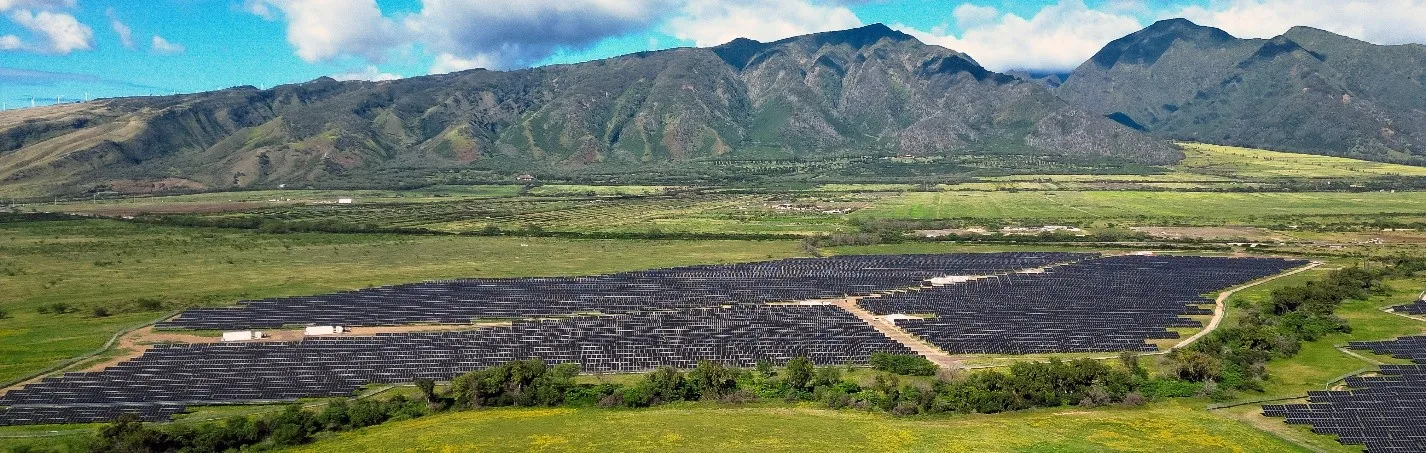
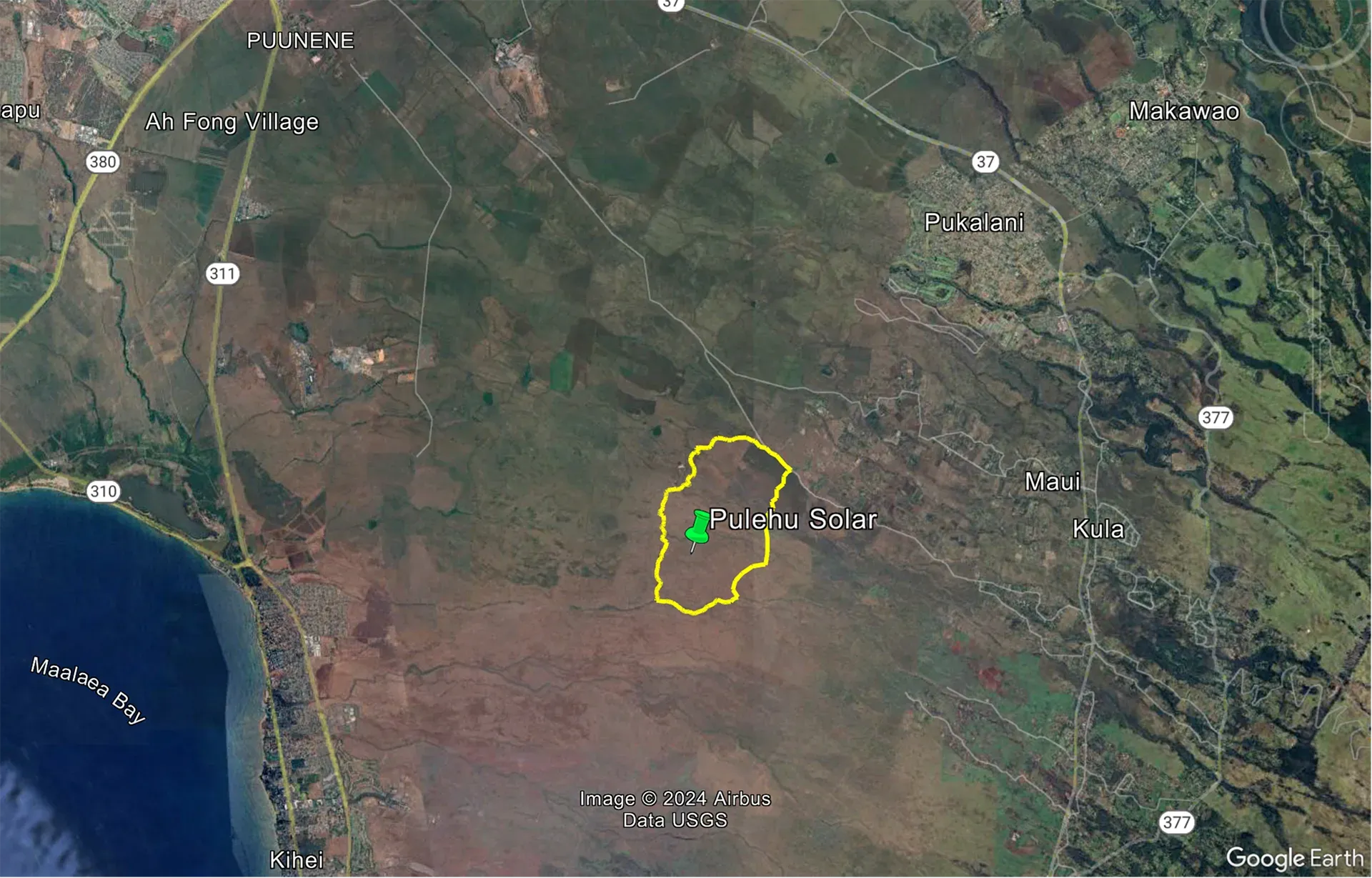
Pūlehu Solar is a proposed 20 MW solar project with an 80 MWh, four-hour battery energy storage system in lower Kula on Maui. The project would include a new substation to connect to the Maui grid and would be located on approximately 363 acres makai of Pūlehu Road.
Hawaiian Electric originally selected the project through its Stage 2 RFP. Supply-chain constraints and rising equipment costs later required the project to be re-bid through the Stage 3 RFP, where it was selected again. AES acquired the project in September 2026 as part of its commitment to advancing Hawaiʻi's clean energy transition and delivering long-term benefits to the Maui community. Under a 20-year agreement, the project is expected to provide enough clean energy to power the equivalent of 9,873 Maui households at a fixed rate.
- Specifications: 20 MW solar photovoltaic array plus an 80 MWh containerized lithium-ion Battery Energy Storage System (BESS).
- Power Purchase Agreement: The project will deliver power to serve Maui residents under a 20-year Power Purchase Agreement with Maui Electric (MECO) at a fixed cost over that time span.
- Decommissioning: At the end of the Project's life, AES Hawaiʻi will restore the land to its existing condition (or comparable).
- Project area: The Project will be sited with a Project Permit Area of 363 acres, with a smaller subset expected to house project infrastructure.
Project name
Pūlehu Solar
Owner/Developer
Pūlehu Solar, an affiliate of AES
Project capacity (MW)
20 MW
Proposed facility location
Lower Kula, Maui
TMK of facility location
TMK: (2) 2-5-001:003
Hawaiʻi’s 100% clean energy future
As Hawai'i accelerates its transition to a 100% renewable future by 2045, AES Hawai'i is partnering with utilities, communities, landowners and customers to deliver greener, smarter energy solutions and help ensure a responsible and equitable transformation to clean energy. Since the 1990s, our people have worked passionately to meet Hawai'i’s growing energy needs. Working together, we are co-creating solutions that support Hawai'i’s renewable generation goals, stabilize rates, and increase grid reliability.
Up to 5% of Maui’s annual electricity
The project is expected to generate up to 5% of Maui’s electricity annually, enough to power the equivalent of 9,873 local homes.
Local jobs during construction and operations
The project is expected to create more than 100 construction jobs and 1–2 long-term operations positions, with a priority on hiring workers from Maui and the rest of Hawaiʻi where possible.
Reduced fossil fuel use and greenhouse gas emissions
By adding locally generated solar energy and storage to the Maui grid, the project would help reduce the utility’s need to burn fossil fuels and lower greenhouse gas emissions.
Stable energy costs from local renewables
The project would help provide long-term price stability through locally sourced renewable energy, avoiding the fluctuations associated with fossil fuel based generation.
Project layout
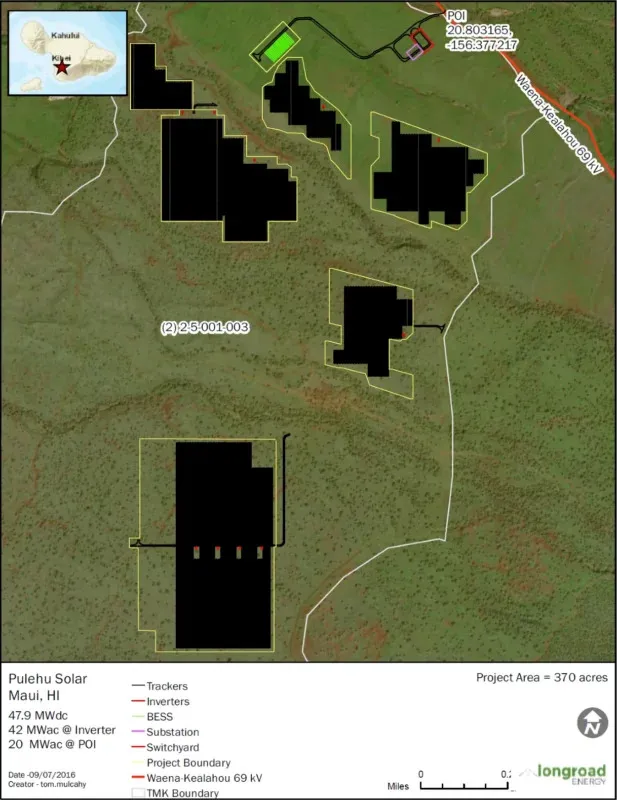
Project maps are currently being updated and will be updated on the project website once available.
Proposed interconnection route
The project is proposing to interconnect to the Hawaiʻi Electric Light Company grid via 69kV transmission lines.
AES Hawai'i is deeply committed to being an active, invested member - and neighbor - of the communities we serve.
We have a track record of successfully and sensitively engaging with the communities near the proposed projects. Being a responsible community partner is fundamental to our values and will guide how we approach community outreach for Pūlehu Solar. The outreach plan will build on the project’s prior outreach history while refreshing engagement for the current project phase and any updated assumptions following acquisition, redesign, permitting, or schedule changes.
AES Hawaiʻi’s standard practice is to invite stakeholders to help identify others in the community who should be contacted, enabling the Project Team to continually expand outreach. AES Hawaiʻi also welcomes input on stakeholders to include in outreach efforts through the Project email address, website and hotline. AES Hawaiʻi will maintain a comprehensive and regularly updated stakeholder list and document all stakeholder engagement activities.
-
Early-stage outreach
-
Pūlehu Solar has been the subject of community outreach efforts since 2017, engaging residents, community organizations, businesses, cultural practitioners, community leaders, and government officials in and around the greater Pūlehunui and Kula areas.
Outreach included stakeholder meetings, community association engagement, public community meetings, and discussions with individuals familiar with the area's historical, cultural, and environmental context. Feedback gathered during this process helped identify community priorities, project benefits, and areas of concern.
As the project advances, AES Hawaiʻi intends to build upon this existing outreach history through proactive and ongoing stakeholders engagement. The objective of this engagement is to share project information, solicit feedback, address questions and concerns, and better understand community priorities and potential impacts to help guide project development.
-
Comprehensive communications plan
-
A significant goal of AES Hawaiʻi’s Community Outreach Plan is to inform stakeholders and neighboring communities about the Project and its progress and collect their feedback. AES Hawaiʻi will continue to build upon our previous experience to provide timely updates through a comprehensive community outreach schedule. AES Hawaiʻi is committed to sharing important information about the Project in advance of any community meetings. Specific tactics to share information and gather input include, but are not limited to:
- Issuance of Public Community Meeting Notice(s);
- Conducting Public Community Meeting(s);
- Conducting strategic outreach to area organizations, community leaders, and elected officials;
- Dedicated Project email address (pulehusolar@aes.com) to gather input, comments, and questions;
- Dedicated Project phone number (+1 (808) 800-3942);
- Dedicated Project website (https://www.aes-hawaii.com/pulehu-solar) with updated information and a portal to gather input, comments, and questions;
- Issuance of monthly project status updates to the Project mailing list; and
- Public Community Meeting Summary posted to the Project website.
Our ongoing community outreach efforts include informing stakeholders and neighboring communities of the Project and answering questions.
AES Hawaiʻi will continue to plan for either in-person or virtual community meetings as requested. To support community awareness of public meetings, AES Hawaiʻi will issue media advisories a minimum of 30 days prior to a public meeting to Hawaiʻi Island and statewide media, including but not limited to, The Maui News, Maui Now, Civil Beat, Hawaiʻi News Now, KHON2 News, and KITV4 News. Additionally, we will advertise in area community publications and provide email notifications to stakeholders and those who have signed up for updates through the Project mailing list.
Public comments supporting and opposing the proposed project will be compiled and filed with the Public Utilities Commission.
AES Hawaiʻi believes in the importance of maintaining community collaboration and consultation throughout the project lifecycle and has successfully implemented this strategy with Hawaiian Electric Company’s RFP Phase 1 & 2 projects. Throughout this process, collecting, considering, and responding to feedback from stakeholders and neighboring communities enabled AES Hawaiʻi to garner support and tailor each project to address and mitigate community-identified issues or concerns.
One of the earliest steps we take when starting a new project is to engage area community leaders, elected officials, residents, key government and industry organizations, and businesses. This approach enables AES Hawaiʻi to share information about the Project, build support, and respond to and develop mitigation measures for community-identified issues of concern.
Construction-related updates
AES Hawaiʻi is committed to providing project status updates via email to our Project mailing list at least once per month and in conjunction with key milestones to ensure community members and stakeholders have the opportunity to provide feedback as required by the RFP. The Project website may also be updated on an ongoing basis as benchmarks are achieved.
-
Community benefits
-
AES Hawaiʻi understands that each community in Hawaiʻi is unique, with different issues, priorities, and needs. As outreach continues, the Project Team will gather input and feedback to further refine design, inform future engagement, and identify beneficiaries of the Community Benefits Program (CBP). Pūlehu Solar's CBP will distribute $3,000 per MW per year throughout the project's 20-year operating period to fund priority needs of the community.
Early outreach and stakeholder discussions have provided preliminary insight into community priorities. Feedback received to date has identified wildfire mitigation, natural resource management, Native Hawaiian cultural programs, and clean energy education as areas of interest for future community investment.
As outreach continues, the Project Team will continue to consult with community members and stakeholders to better understand local priorities and identify potential beneficiaries of the Community Benefits Program. Community feedback will help shape future funding priorities and ensure that community benefit initiatives reflect the needs and interests identified by the host community.
As project development advances, additional opportunities for community benefits will continue to be explored in collaboration with area communities and stakeholders.
- Regulatory approvals
-
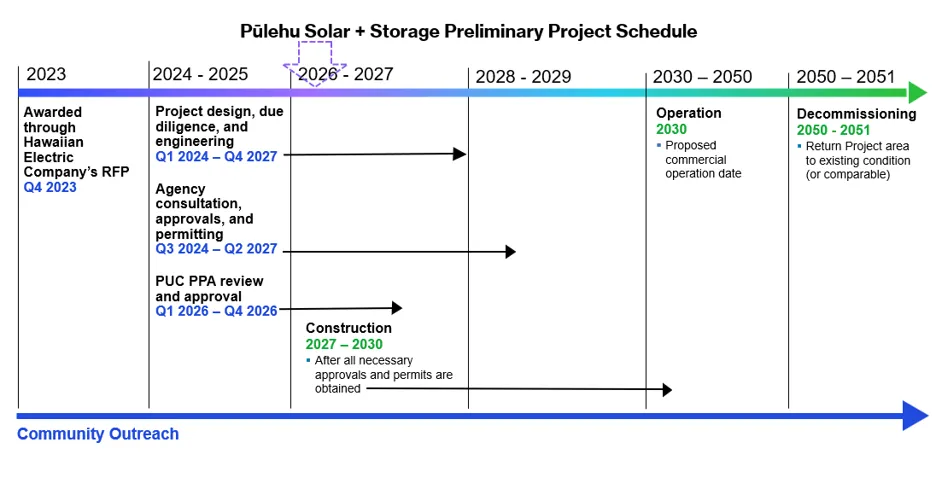
Anticipated Permit/Approval Authority Having Jurisdiction County Special Use Permit (SUP) and any required extensions/validations County of Maui Planning Department and Maui Planning Commission HRS Chapter 6E Compliance (Historic Preservation Review) State Historic Preservation Division (SHPD)
Grant of Access State of Hawaiʻi Department of Transportation (HDOT) Right-of-Way Branch National Pollutant Discharge Elimination System (NPDES) Permit State of Hawaiʻi Department of Health (DOH), Clean Water Branch Noise Permit DOH, Indoor and Radiological Health Branch Building and Electrical Permits County of Maui Department of Public Works Grading, Grubbing and Stockpiling Permits County of Maui Department of Public Works -
Community meetings and presentations
-
March 13, 2025 Pūlehu Solar Public Meeting
Community Outreach Plan
Environmental Permits and Approvals Strategy
The Project Team has identified permits and approvals required for the Project, which are further described in the Project Milestones. As part of its commitment to engaging the community, the Project Team will keep community members and key stakeholders updated on the status of permits and approvals to ensure they can engage in the process and continue to provide their feedback.
Preliminary Assessment of Environmental Conditions
AES Hawaiʻi is deeply committed to supporting the environment through sensitive design, construction, and operational practices. As part of this commitment, the Project Team had previously conducted a preliminary assessment of the environmental conditions at the site. More detailed information is being obtained through the due diligence and expert consultant studies.
Cultural and Historic Resources
AES Hawaiʻi takes the Archaeological and Cultural Resources review very seriously. This project has undergone extensive Archaeological and Cultural reviews (via Ka Paʻakai Analysis) to gain a comprehensive understanding of the land and any potential impacts resulting from the proposed development. The study concluded that the Project will not affect or impair valued cultural, historical, or natural resources at the Project Site, including traditional and customary Native Hawaiian rights.
Community Outreach Representative: Carrice Gardner
Email: pulehusolar@aes.com
Project Hotline: +1 (808) 800-3942