

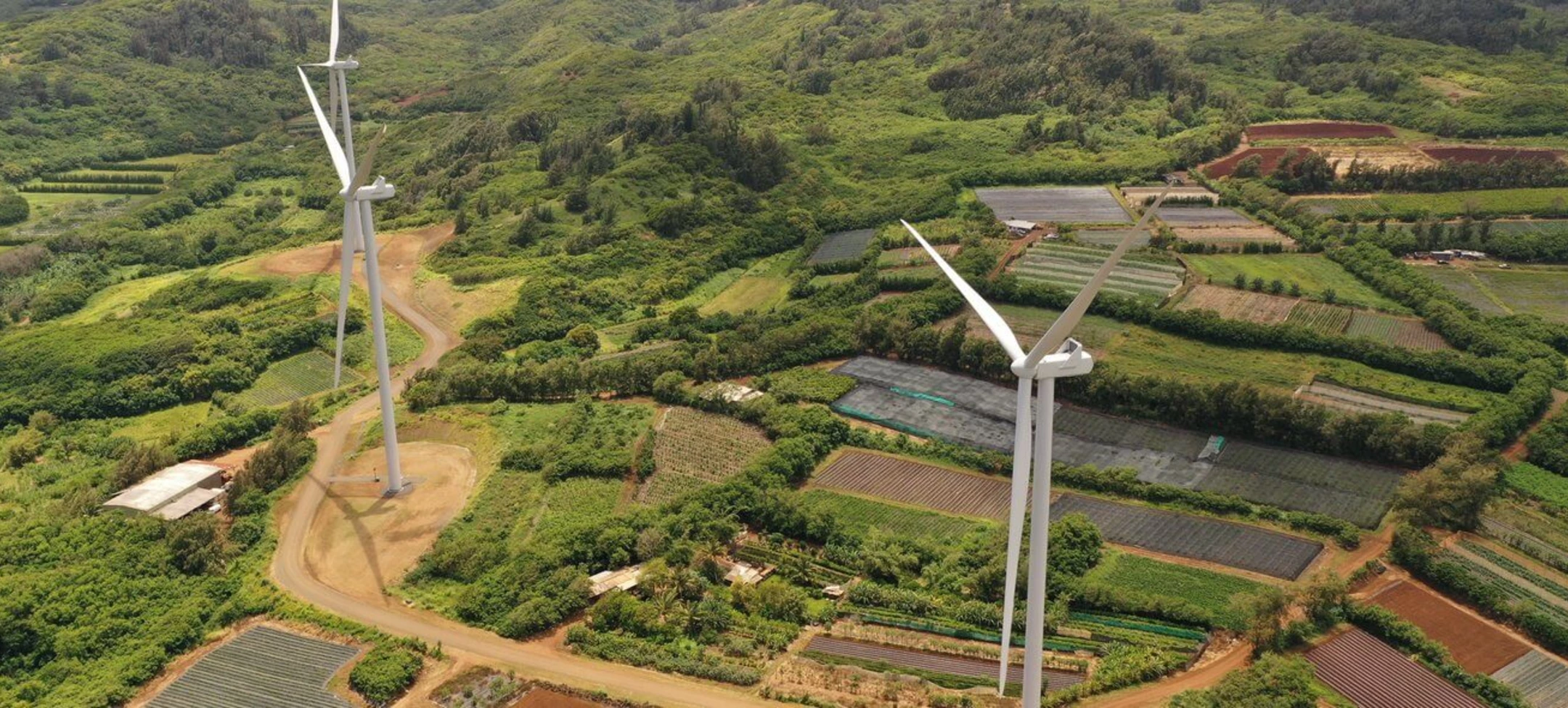
Nā Pua Makani is a wind energy project in the town of Kahuku on O‘ahu’s North Shore. The project consists of 8 wind turbines that harness the plentiful wind resources of the area and convert it into renewable, sustainable energy for the island.
One of the most powerful and efficient sources of clean, renewable energy in the state of Hawai‘i, Nā Pua Makani generates enough electricity to power the equivalent of 16,000 homes and has produced more than 500,000 MWh of power to date. This project contributes to Hawai‘i’s energy security by reducing the state’s reliance on expensive, imported fossil fuels.
Nā Pua Makani is one of 12 AES Hawaiʻi projects in operation or under development across the islands of O‘ahu, Maui, Kaua‘i, and Hawai‘i Island, together producing more than 400 MW of clean energy. AES has proudly served the people of Hawai‘i since 1991, and is proud to support the state's transition toward a sustainable, renewable energy future and goal of reaching 100% renewable energy by 2045.
Benefits of Nā Pua Makani
Supporting the North Shore Community
AES Hawaiʻi is deeply committed to being good neighbors to the North Shore community. Their input has played a key role in shaping our community benefit commitments for Nā Pua Makani, ensuring they provide lasting local impact.
Our Commitment to Community Benefits
We're proud to have invested in the long-term wellbeing of the North Shore community through meaningful, community-driven partnerships.
- $5 million investment though the AES Hawaiʻi Foundation
This commitment began with a $2.5 million contribution, along with up to $1.5 million in additional matching funds to support a long-standing community priority, identified through ongoing dialogue with the community. Building on that momentum, an additional $1 million was committed to further support the community's vision.
In partnership with the City & County of Honolulu, these funds will help advance the community's vision for Kahuku District Park, including community gathering spaces, expanded parking, an eight-lane swimming pool, and ADA-accessible features, all with the goal of creating safe spaces for physical activity, youth programming, and community events.
Click here for more information about the project and progress updates
- Ongoing support for local opportunity
Since Nā Pua Makani began commercial operations, the project has provided an annual $80,000 contribution to the North Oʻahu Hometown Opportunities, Inc., and an annual $20,000 contribution to the Lā‘ie Community Association, supporting efforts that continue to strengthen the local community year after year.
Project specifications
8
Wind turbines
24
Megawatts generated
20
Years purchased power
70,000
Tons of CO2 saved
16,000
Homes powered
Nā Pua Makani is capable of producing 24 megawatts of wind energy – enough to power up to 16,000 homes annually and reduce CO2 emissions by up to 70,000 tons each year.
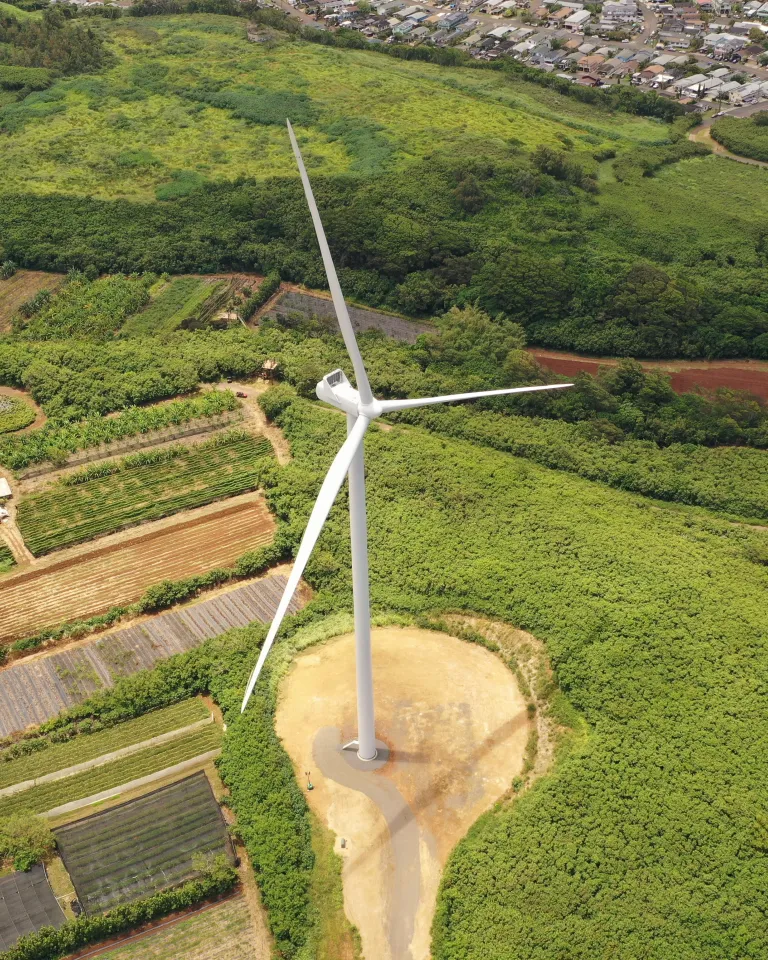
Based on public comment, Nā Pua Makani reduced the planned quantity of turbines from 13 to 15 turbines down to a total of 8 turbines, by increasing the height. The higher you get from the ground, the stronger and more steady the winds are. A turbine’s capability to produce power increases significantly with height, as does its efficiency. The height of the turbines are approximately 568 feet from the base to the tip of the rotors. The hub height is approximately 345 feet.
A full noise study was conducted as part of the Environmental Impact Assessment (EIS) to ensure operational sound reaching the Kahuku residential area and neighboring schools will stay at or below the Hawaii Department of Health Sound Level Limit at night. In the Kahuku residential area and neighboring schools, the sound level will not exceed 45 decibels, which is comparable to light traffic in Kahuku. Upon operation, Nā Pua Makani has a North Shore team leader available to answer questions or comments about operational noise concerns and to ensure appropriate follow-up actions occur. Please visit the contact page to reach out to us.
Wind turbines have not been shown to have an adverse impact on human health. No studies have identified a direct link between turbines and long-term health impacts such as hypertension, cardiovascular disease, high blood pressure, tinnitus, headache/migraine, hearing impairment, or other diseases. Shadow flicker and noise from the turbines have not been shown to pose a health risk.
Shadow Flicker: Shadow flicker is a moving shadow created by turbine blades located between the sun and an observer. For shadow flicker to be observed, there must be a direct line of sight between an observer and the incoming shadow flicker. Sunlight and the blades have to be directly facing or facing away from the sun. This means that when shadow flicker effects are observed, it’s typically for a short duration during the low angle sunlight hours, just after sunrise and just before sunset. The farther from the turbine a person is, the less noticeable the shadow flicker would be. Shadow flicker would primarily be contained within the wind farm site and the amount of potential flicker extending into adjacent areas would be relatively short in duration and low in intensity.
Shadow flicker does not have the potential to trigger epileptic seizures as epileptic seizures are precipitated by light flashes in the range from 5 to 30 Hz. The proposed project’s wind turbine blade-pass frequency is approximately 0.59 Hz, or less than 1 alternation per second, so no negative health effects to individuals with photosensitive epilepsy are anticipated. More information is available on the Epilepsy Society website here: https://epilepsysociety.org.uk/about-epilepsy/epileptic-seizures/seizure-triggers/photosensitive-epilepsy
Noise: No scientific peer-reviewed study shows a direct link between living close to turbines, and the noise they emit (audible and inaudible), and physiological health effects. Predicted sound levels for Nā Pua Makani are not expected to result in annoyance, sleep disturbance, or other health effects in the general population. Nā Pua Makani is not expected to have disproportionate effects on people with autism or heightened noise sensitivity because the project’s audible noise would be low and, in most cases, imperceptible above the existing ambient noise.
Nā Pua Makani’s Habitat Conservation Plan, developed over three years in consultation with the Division of Forestry and Wildlife and the U.S. Fish and Wildlife Service and approved by the Board of Land and Natural Resources in 2018, has three protective components:
- Prevention — Consistent with nearby wind facilities, Nā Pua Makani’s low wind speed curtailment is the most effective known approach to reducing bat fatalities. In addition, AES has implemented in coordination with wildlife agencies a pilot bat deterrent system similar to the deterrent systems running at other wind facilities with promising results.
- Monitoring — Onsite operations staff will be trained to recognize any incidents of harm to bats or other species and they will conduct surveys below the turbines to document any such impact. Additionally, Nā Pua Makani will have regular monitoring by trained biologists, the Division of Forestry and Wildlife and the U.S. Fish and Wildlife Service.
- Restoration — To benefit the Hawaiian hoary bat and other protected species, Nā Pua Makani will invest $4.2 million to monitor wildlife impacts on site and to provide materials, personnel and support for habitat restoration at the Poamoho Natural Area Reserve. By preserving habitat outside the wind farm, Nā Pua Makani avoids attracting bats near the turbines. Nā Pua Makani will also support research into the life history and needs of the endangered bat population.
The City and County requires that wind turbines be set back from all property lines a minimum distance equal to the height of the system, including the height of the tower and its farthest vertical extension (to the tip of its blade). Nā Pua Makani is in compliance with all county setback requirements.
Nā Pua Makani employs a small staff to operate and maintain the wind farm that includes an experienced site manager and wind BOP engineer, as well as wind technicians. We also employ local companies for support activities, such as electrical, mechanical, landscaping, and environmental monitoring.
Renewable energy gains are measured by the equivalent tons of CO2 emissions reduced on an annual basis. Nā Pua Makani reduces CO2 greenhouse gas emissions by approximately 70,000 tons annually, which is equivalent to taking off the road approximately 13,000 passenger vehicles for an entire year.
In times of no wind or during outages to perform maintenance, the turbines are at rest and no electricity is generated. However, when the wind does blow the location and height of our turbines places them in an excellent position for harnessing and producing renewable energy from the wind.
No. Wind-generated power does not produce any greenhouse gas emissions.
The anticipated life of the project is 20 years based on the term of the 20-year Power Purchase Agreement with HECO. Prior to expiration of this agreement, Nā Pua Makani will evaluate whether to continue operation of the wind farm or to decommission it. Should the period of the project’s operation be extended, the appropriate agreements will be obtained, which may include upgrading or repowering the facility. If the project is decommissioned, the power generation equipment will be removed, and the site restored as closely to its original state as possible.
The community benefits package associated with Nā Pua Makani began with a $2.5 million contribution, along with up to $1.5 million in additional matching funds to support a long-standing community priority, identified through ongoing dialogue with the community. Building on that momentum, an additional $1 million was committed to further support the communityʻs vision, for a total of $5 million being contributed through the AES Hawaiʻi Foundation. In partnership with the City & County of Honolulu, these funds will help advance the community’s vision for Kahuku District Park, including community gathering spaces, expanded parking, an eight-lane swimming pool, and ADA-accessible features, all with the goal of creating safe spaces for physical activity, youth programming, and community events.
To date, AES Nā Pua Makani has donated nearly $90,000 to support community initiatives in the following areas:
COVID-19 relief, education, sports, and culture and the arts.
Additionally, since Nā Pua Makani began commercial operations, the project has provided an annual $80,000 contribution to the North Oʻahu Hometown Opportunities, Inc., and an annual $20,000 contribution to the Lāʻie Community Association, supporting efforts that continue to strengthen the local community year after year.
The large propeller-like blades of a turbine are designed to capture the kinetic energy of the wind. When the turbine blades begin moving, they spin a shaft that leads from the hub of the rotor to a generator, which turns that rotational energy into electricity.
Wind is a cost-efficient source of power. More wind-generated power reduces our reliance on expensive, imported oil.
The City and County requires that wind turbines be set back from all property lines a minimum distance equal to the height of the system, including the height of the tower and its farthest vertical extension (to the tip of its blade). For this project, the minimum setback, based on the County ordinance is 568 feet. In response to community feedback, Nā Pua Makani turbines have been were relocated and the closest turbine is approximately 1,700 feet from the closest home and approximately 1,750 feet from Kahuku High School.
Yes, a joint state and federal environmental impact statement has already been prepared, which takes into consideration all impacts including economic, social, transportation and any effects on the physical environment such as air, water and noise. We have also conducted a study under the federal National Environmental Policy Act (NEPA) and have worked with the U.S. Fish and Wildlife Service (USFWS). DLNR, and the Division of Forestry and Wildlife (DOFAW) to prepare a Habitat Conservation Statement.
The wind turbines are designed to withstand hurricane force winds and other severe weather such as a lightning strike.
Let’s get in touch.
Address:
Nā Pua Makani
56-380 Kamehameha Highway
Kahuku, HI 96731